

Wildlife Artwork Stories
Gone Fishing
From Wildlife Hide to Drawing Board
The story behind a coloured pencil kingfisher drawing, beginning with Mal from Wild Lens Images in the field and ending at the Gwatkin Artworks drawing board.

Mal’s camouflaged hide set up near the water — part of the careful fieldwork behind the reference image.
Photo courtesy of Wild Lens Images.
It began beside the river
Gone Fishing began long before pencil touched paper.
I wanted to share the story behind this artwork, and how the piece took shape from fieldwork to the drawing board. The journey started quietly beside a river, where Mal from Wild Lens Images patiently waited for a kingfisher to appear.
Wildlife photography is a pursuit defined by stillness, perfect timing and deep respect for the subject. It is this patience in the field that provided the foundation for the drawing.
Since kingfishers are highly territorial birds, finding one is only the first step. Once a kingfisher is located, the real planning begins.
Fieldcraft, patience and preparation
Choosing where to place a portable hide is crucial. Light plays a major role in the final photograph, so Mal carefully considers the sun’s position — whether the session is in the morning, afternoon or evening — and sets up the hide to take full advantage of the conditions.
He also arranges a suitable perch at just the right angle, keeping the background, sun direction and final composition in mind.
After all the elements are aligned, the waiting begins.
Inside the hide, Mal sets up his camera manually, avoiding automatic settings so he can maintain full creative control. Aperture, ISO and shutter speed are all carefully selected to suit the light and conditions. On a bright day, he may even underexpose the shot slightly to preserve the delicate whites on the kingfisher’s neck, helping to keep the fine feather detail intact.
Then comes the real test of patience.
The kingfisher may arrive in minutes, or it could take hours. Sometimes, it may not land at all that day. But when it finally does, every part of the preparation — the recce, hide placement, perch, background, light and camera settings — comes together in a single fleeting moment.


The fieldwork behind the photograph: camouflage, careful positioning and long periods of quiet observation.
Photos courtesy of Wild Lens Images.
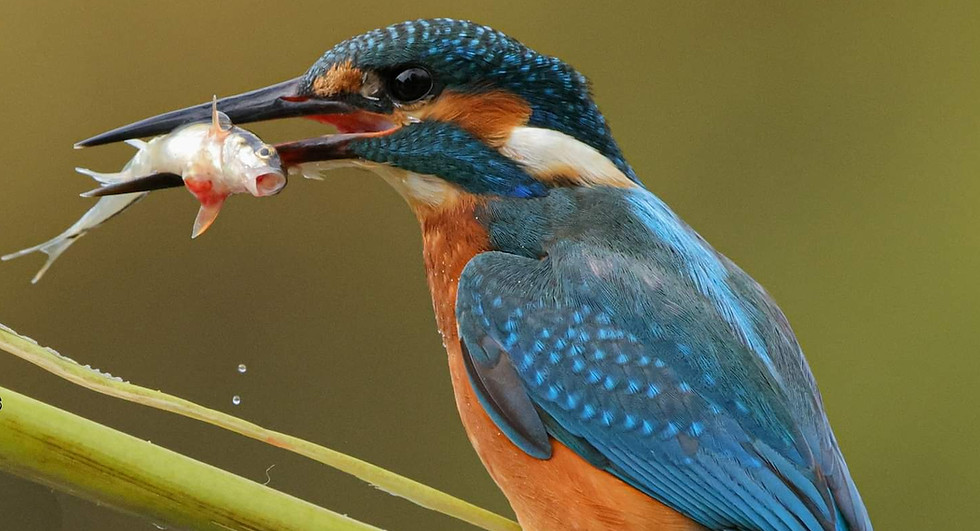
The reference photograph for Gone Fishing, captured by Mal of Wild Lens Images.
Copyright: Wild Lens Images. Used with permission.
Choosing the reference
That fleeting moment became the reference for Gone Fishing.
What immediately stood out to me was the strength of the image. The kingfisher is full of colour and movement, but the photograph also captures a quiet story of survival — the bird balanced on the perch with its catch held firmly in its beak.
For me, this is what makes a wildlife reference image so valuable. It is not simply a photograph of a bird. It is the result of patience, fieldcraft, observation and respect for the natural world.
Mal’s photograph gave me everything I look for in a strong wildlife reference: a clear pose, beautiful detail, natural behaviour, strong colour and a moment that feels alive.
From photograph to drawing board
From there, the process moved from the riverbank to the studio.
Back at the drawing board, I began by studying the reference closely. Before adding colour, I needed to understand the structure of the bird, the angle of the beak, the position of the fish, the shape of the body and the direction of the feathers.
I began with a light pencil outline, mapping out the proportions and placement of the subject. I wanted to preserve the immediacy of the original photograph while allowing the drawing to develop into a finished piece of artwork in its own right.
I started with the head and fish, the natural focal point, to set the character and energy of the drawing before moving into the body and wing.


The first stages of the drawing, beginning with a light outline before slowly building the head, beak and fish.


Building the drawing through slow layers of coloured pencil, gradually refining colour, feather texture and contrast.
Building the drawing
As the drawing developed, I worked slowly through layers of coloured pencil, building the colour and texture bit by bit.
Kingfishers are always rewarding subjects to draw because of their striking colours, but they also require careful handling. The blues need to feel rich and vibrant without becoming too harsh, while the oranges, whites and darker markings all have to sit together naturally.
Much of the work happens gradually. The wing markings are built in stages. The feather direction is refined. The eye is strengthened. Subtle colour shifts are adjusted across the head, body and tail.
Layer by layer, the bird began to emerge.
The finished artwork
The finished drawing brings together two different but closely connected processes: the patience of wildlife photography and the slower, quieter patience of coloured pencil work in the studio.
Gone Fishing is, in many ways, a collaboration between fieldcraft and drawing — between the moment Mal captured through Wild Lens Images and the time taken to reinterpret that moment by hand on paper.
It is also a reminder that wildlife art often begins long before the first mark is made. Behind every finished piece there can be hours of waiting, careful decisions, skilled observation and a shared appreciation for the subject.
For me, that is what makes this piece special. It carries the story of the river, the hide, the reference photograph and the drawing board all in one finished artwork.

Gone Fishing — finished coloured pencil kingfisher artwork by Darren Gwatkin, created from a reference photograph by Wild Lens Images.
About the collaboration
I’m very grateful to Mal of Wild Lens Images for allowing me to work from such a beautiful reference photograph and for sharing the fieldwork behind it.
His photography provided the foundation and inspiration for the piece. My role was to take that fleeting moment and translate it through coloured pencil into a finished artwork — one built slowly through colour, detail and patience.
Thank you, Mal, for your trust and for sharing your incredible work.


