
BEHIND THE ARTWORK

I Was Here First! — The Kingfisher Drawing Featured in Ann Kullberg’s Color Pencil Magazine
FEATURES, EXHIBITIONS & RELEASES
A closer look at the coloured pencil kingfisher drawing that became an important milestone for Gwatkin Artworks after being featured in Ann Kullberg’s Color Pencil Magazine.

I Was Here First! — finished coloured pencil kingfisher artwork by Darren Gwatkin.
A wildlife drawing with a little extra meaning
Some drawings become important not only because of the finished artwork, but because of what they come to represent.
I Was Here First! is one of those pieces for me.
This coloured pencil drawing of two kingfishers became a meaningful milestone for Gwatkin Artworks when it was featured in Ann Kullberg’s Color Pencil Magazine. As an artist working in coloured pencil, having a wildlife piece recognised in that way was a proud moment and a reminder of how far the work has developed over time.
IN THIS STORY
01
A wildlife drawing with a little extra meaning.
02
The idea behind the composition.
03
Starting with the first bird.
04
Creating movement and contrast.
05
Layering colour and feather detail.
06
A meaningful magazine feature
07
The finished artwork.

FEATURED IN
Ann Kullberg's Color Pencil Magazine
A special moment for Gwatkin Artworks and a proud milestone in the journey.

Behind every finished drawing is time, patience and a deep connection with the natural world.

The idea behind the composition
What drew me to this piece was the interaction between the two kingfishers.
Rather than a still portrait of a single bird, the composition has movement, tension and character. One kingfisher is already perched, while the other appears to be arriving with wings open, creating a moment that feels full of energy.
That sense of interaction is what gave the drawing its title: I Was Here First!
Kingfishers are striking subjects because of their colour, but in this piece it was the relationship between the two birds that mattered most. The open wings, the angle of the second bird, and the space between them all helped create a small wildlife story within the drawing.

Early stages of the drawing.

Building the first kingfisher.
Starting with the first bird
The drawing began with the first kingfisher on the left.
At this stage, I was focused on establishing the pose, colour balance and direction of the feathers. The rich orange tones of the breast, the blue of the head and back, and the soft wing structure all needed to be built carefully without becoming too heavy too soon.
With coloured pencil, the early layers are important because they set the foundation for everything that follows. The colours have to be built gradually, allowing room for later adjustments, deeper shadows and refined detail.
Creating movement and contrast
Once the first bird was established, the second kingfisher became the main focus.
This bird brought movement into the drawing. Its wings, body angle and upward position created a different challenge from the perched bird. The open wing required a softer balance of light and shadow, while the body still needed enough colour and contrast to hold attention.
The two birds had to work together as one composition. If one became too dominant, the story of the piece would be lost. I wanted the viewer’s eye to move naturally between them, following the diagonal line of the branch and the implied motion between the two kingfishers.
This is where the drawing began to feel alive.

The second kingfisher begins to emerge, adding movement and energy to the composition.

First bird being developed.

Second bird colour beginning to grow.
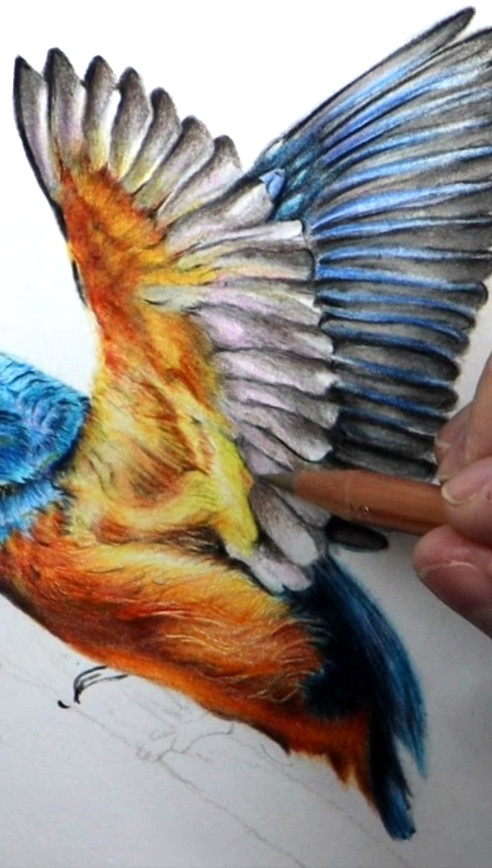
Wing detail developing.
Layering colour and feather detail
Kingfishers are wonderful subjects for coloured pencil because their colours are so vivid, but that also means they need careful handling.
The blues, oranges and darker markings have to feel vibrant without becoming harsh. The wings need structure, but they also need softness. The feathers need detail, but not so much that the whole drawing becomes overworked.
Much of the process involved slowly strengthening the contrast, refining the feather edges and adjusting the colour transitions. The wing feathers in particular needed patience, with darker tones added gradually to create depth and separation.
The drawing was built slowly, layer by layer, until the birds began to sit together as a finished wildlife scene.
A meaningful magazine feature
After the drawing was completed, I Was Here First! went on to be featured in Ann Kullberg’s Color Pencil Magazine.
That was a special moment for me and a reminder that each piece is part of a wider journey in building Gwatkin Artworks.
Coloured pencil is often a slow and detailed medium, and a piece like this represents many hours of careful work. To have the drawing recognised and featured gave the piece an added significance beyond the finished artwork itself.

Featured in Ann Kullberg’s Color Pencil Magazine.

The finished artwork, I Was Here First!, created in coloured pencil.
The finished artwork
The completed piece brings together colour, movement and a small moment of wildlife character.
For me, I Was Here First! is not just about two kingfishers. It is about timing, interaction and the energy of a moment that feels as though it could disappear in an instant.
That is what I enjoy most about wildlife artwork — trying to capture not only what the subject looks like, but something of its presence and behaviour.

Inspired by wildlife. Built through patience.
Behind every finished drawing is a slower process — the reference, the composition, the early marks, the colour choices and the final details that bring the artwork together.
I Was Here First! became a meaningful part of that journey, and a piece I’m proud to include in the Gwatkin Artworks wildlife collection.